

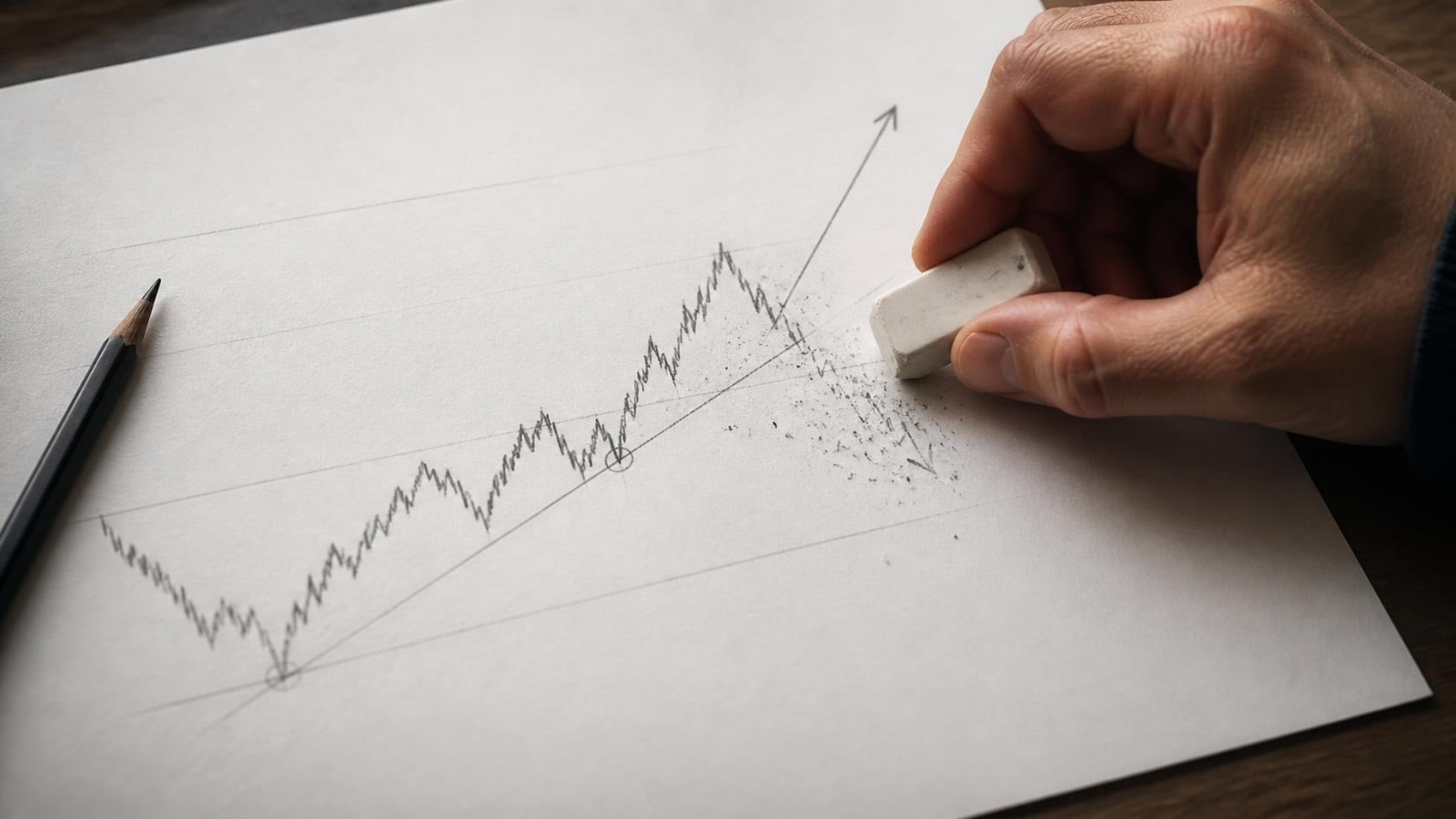
Markets Are Never Wrong — Opinions Often Are
MARKET MINDSET
Editorial Journal on Capital Markets, Trading Psychology & Professional Decision-Making
An Editorial by Debaditya Chatterjee
Editor, Market Mindset
Capital Markets Educator | Trader & Investor | Helping Market Participants Think Like Professional Market Participants | Market Psychology | Trading Discipline | Capital Markets Research
“Markets are never wrong — opinions often are.”
— Jesse Livermore
There is a dangerous moment in every trader’s journey.
It is not when the market moves against the position.
It is when the trader begins arguing with the market.
The price falls, but the trader says the stock is still fundamentally strong.
The breakout fails, but the trader insists it is only a temporary shakeout.
The support breaks, but the trader keeps looking for reasons why it should hold.
The position loses money, and instead of reconsidering the thesis, the trader starts defending it.
This is where an opinion can become more powerful than evidence.
Jesse Livermore’s observation points toward one of the most difficult disciplines in trading:
Knowing when the market is telling you that your opinion needs to change.
The Market Does Not Know Your Thesis
The market does not know where you entered.
It does not know how much research you conducted.
It does not care how strongly you believe in a stock.
It does not know whether you have been trading for ten years or ten days.
And it certainly does not owe you validation.
Price simply reflects the continuous interaction of buyers, sellers, expectations, liquidity, information and uncertainty.
That is why one of the most important skills a trader can develop is the ability to separate:
What I think should happen.
From:
What the market is actually showing me.
The difference appears small.
In practice, it can determine whether a trader learns from a position or becomes trapped inside it.
An Opinion Is a Hypothesis, Not a Fact
Every market view begins as an interpretation.
Perhaps the earnings outlook appears attractive.
Perhaps the price structure looks bullish.
Perhaps momentum is strengthening.
Perhaps institutional participation appears to be increasing.
Perhaps valuation appears reasonable.
All of these observations can contribute to a thesis.
But a thesis remains a thesis.
It is not reality itself.
The moment we treat our interpretation as fact, we become less receptive to contradictory evidence.
A disciplined trader therefore needs an internal sentence that sounds simple but is surprisingly difficult to follow:
“I could be wrong.”
That is not pessimism.
It is intellectual humility.
And in markets, intellectual humility can be a form of risk management.
The Cost of Confirmation Bias
Confirmation bias is particularly dangerous because it rarely feels like bias while it is happening.
A trader holding a bullish position naturally notices bullish information.
A positive earnings surprise becomes important.
An analyst upgrade becomes important.
A strong sector move becomes important.
But disappointing information suddenly becomes “temporary.”
A weak chart becomes “noise.”
A failed breakout becomes “manipulation.”
The trader has stopped analysing the market.
The trader is now defending a position.
This distinction matters.
Research should challenge a thesis as much as it supports one.
A powerful question before taking a position is:
“What evidence would make me change my mind?”
If there is no answer, the position may be based more on conviction than on analysis.
Price Is Not Always Right About Value — But It Is Always Telling You Something
This requires an important nuance.
Livermore’s statement should not be interpreted to mean that market prices are always fundamentally correct.
Markets can become excessively optimistic.
They can become irrationally pessimistic.
They can overshoot.
They can experience bubbles, panics and temporary distortions.
But from a trader’s perspective, arguing that the market “should” be somewhere else does not change where it actually is.
That is the crucial distinction.
You may believe a stock is worth ₹1,000.
If the market is pricing it at ₹700, your valuation may eventually prove correct.
But until the market recognises that value, your opinion remains an opinion.
Price is the evidence of what participants are willing to pay and accept at that moment.
The professional question is not:
“Why doesn’t the market agree with me?”
It is:
“What is the market telling me, and what might I be missing?”
The Trader’s Job Is Not to Win an Argument
This is one of the most useful psychological shifts a trader can make.
You are not competing against the market.
You are not trying to prove your analysis superior.
You are not trying to win an argument against other participants.
You are trying to make decisions under uncertainty.
That means changing your mind is not defeat.
It is adaptation.
If new information invalidates the original thesis, exiting the position is not an admission that the trader is unintelligent.
It may be evidence that the trader is listening.
Ask Better Questions
A presentation of information can be impressive.
But better questions often produce better decisions.
Instead of asking:
“Why will this stock rise?”
Ask:
“What would cause this stock not to rise?”
Instead of:
“Is this a good company?”
Ask:
“What assumptions are already reflected in the current valuation?”
Instead of:
“Will this breakout work?”
Ask:
“What evidence would confirm or invalidate this breakout?”
Instead of:
“Why am I still holding?”
Ask:
“If I had no position today, would I initiate one at the current price?”
These questions force the trader to step outside the emotional comfort of an existing position.
The Customer Is Not the Chart — The Decision-Maker Is
Markets contain endless information.
Indicators.
Candlesticks.
Moving averages.
Oscillators.
Volume.
Financial statements.
News.
Economic data.
Options data.
None of these automatically creates a good decision.
The value comes from understanding what the information means in context.
This is also why market education should never be reduced to teaching people which indicator to use.
A tool is useful only when the person using it understands its purpose, limitations and appropriate context.
A trader does not need more tools simply because more tools exist.
The trader needs better questions.
Better processes.
Better risk awareness.
Better interpretation.
And ultimately, better decisions.
Simplicity Can Be a Competitive Advantage
Modern markets provide access to an extraordinary amount of information.
The challenge is no longer simply finding information.
It is deciding what deserves attention.
A trader can have multiple screens, dozens of indicators and sophisticated software and still make an undisciplined decision.
Another trader can work with a relatively simple framework and execute consistently.
Technology can improve analysis.
It cannot replace judgment.
The ability to identify what matters—and ignore what does not—may be more valuable than continuously adding another tool to the trading process.
When Price Becomes the Teacher
One of the best habits a market participant can develop is to allow every position to teach something.
If a breakout fails, study why.
If a trend accelerates, study what preceded it.
If a thesis works, examine whether the process was sound or whether luck played a role.
If a trade loses money, determine whether the loss came from poor analysis, poor execution, inappropriate position sizing or simply an unfavourable outcome within a reasonable probability.
The objective is not to avoid every mistake.
That is impossible.
The objective is to make sure the same mistake does not have to teach you the same lesson repeatedly.
Trust Begins With Intellectual Honesty
There is another lesson hidden inside Livermore’s observation.
Credibility does not come from pretending to know everything.
It comes from being honest about what we know, what we do not know and what could change our view.
As a trader, investor and market educator, I believe this distinction matters enormously.
Anyone can present a confident market opinion.
Far more valuable is the ability to explain:
Why you believe something.
What evidence supports it.
What evidence contradicts it.
What risks could invalidate it.
And what you would do if you are wrong.
That is where education becomes useful.
It moves beyond giving people an answer and helps them develop the ability to think for themselves.
From the Editor’s Desk
The longer I remain around markets, the more humbling they become.
There is always another event we did not anticipate.
Another price movement we misunderstood.
Another assumption that proves incomplete.
Another situation that reminds us that markets cannot be controlled.
That is perhaps one of the greatest lessons trading has given me.
I do not have to be right about everything.
I have to remain willing to listen.
If the evidence changes, my view should change.
If the market structure deteriorates, I should reassess.
If the risk becomes unacceptable, I should respect it.
And if the market proves my opinion wrong, the appropriate response is not resentment.
It is learning.
Jesse Livermore’s observation remains powerful because it reminds us of something that is easy to forget:
Our opinions are temporary.
The market is the environment in which those opinions are tested.
We can analyse.
We can forecast.
We can build models.
We can develop strategies.
But eventually, our ideas meet reality.
The professional trader does not need to eliminate opinions.
The professional trader needs to hold them lightly enough to change them.
Because the real advantage may not come from having the strongest conviction.
It may come from having the discipline to abandon conviction when the evidence no longer supports it.
Markets will continue to move.
Our opinions will continue to change.
The real question is whether we are humble enough to let the second respond to the first.
About the Editor
Debaditya Chatterjee is the Editor of Market Mindset, an editorial publication focused on capital markets, trading psychology and professional decision-making.
As a Capital Markets Educator, Trader & Investor, he writes about market psychology, technical analysis, risk management, trading discipline and evidence-based decision-making to help market participants develop professional thinking.
Editorial Disclaimer
This editorial is published solely for educational and informational purposes. The views expressed are intended to encourage informed discussion on capital markets, trading, investing and professional decision-making.
Nothing contained in this publication should be interpreted as investment advice, research recommendations or an offer to buy or sell any financial instrument.
Readers should conduct their own independent research and consult qualified financial professionals before making investment decisions.