

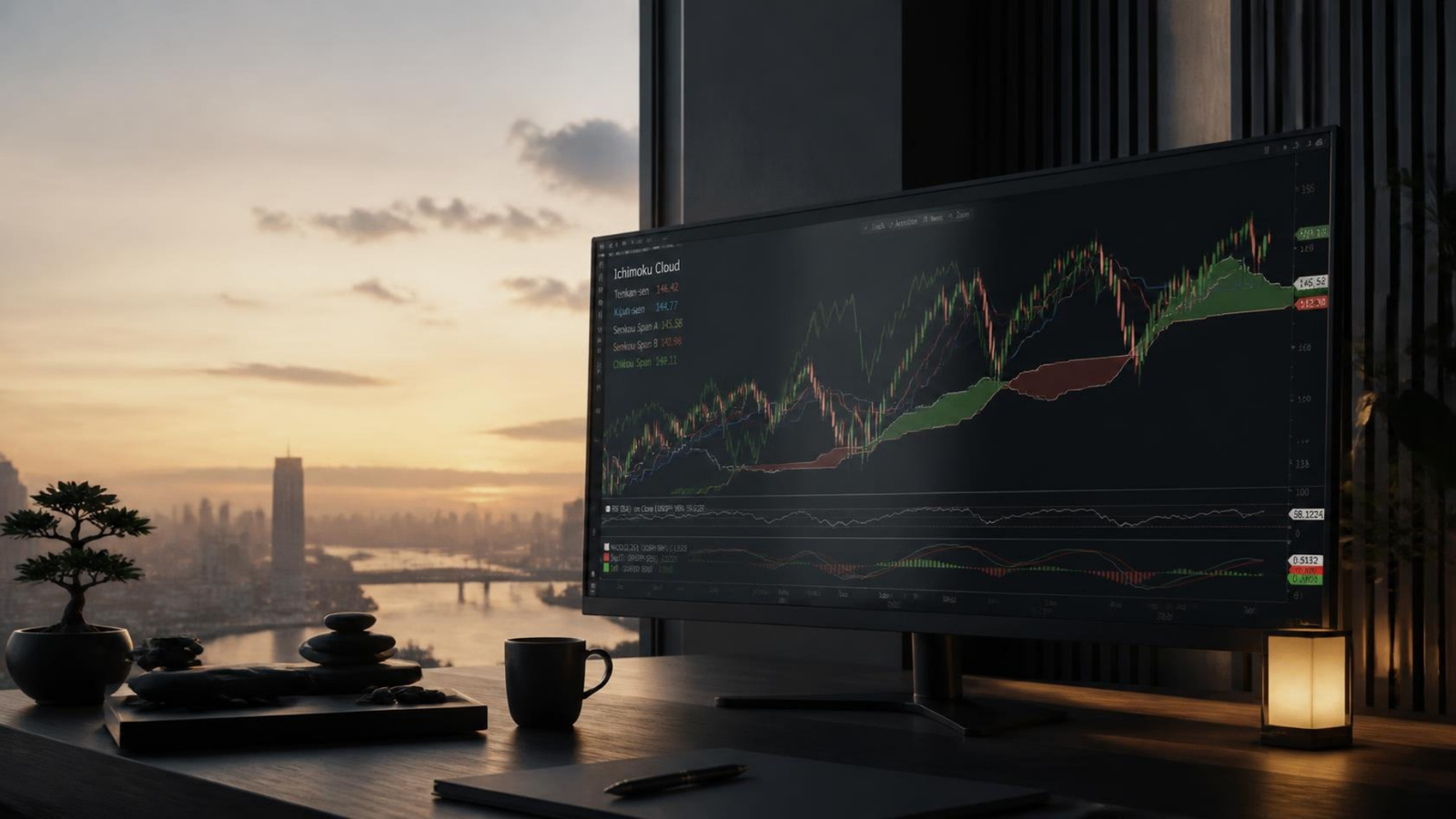
Ichimoku Cloud: The Search for Clarity in an Uncertain Market
An editorial reflection on one-glance market analysis, discipline, and the philosophy of Goichi Hosoda
“The purpose of analysis is clarity, not complexity.”
— Goichi Hosoda
An editorial by Debaditya Chatterjee for INVSTORY.
Financial markets have never suffered from a lack of information.
They suffer from an excess of it.
Every day, investors and traders are surrounded by economic data, corporate announcements, price movements, opinions, and predictions. The real challenge is not finding information. The challenge is identifying what truly matters.
This search for clarity was the foundation behind the work of Goichi Hosoda, the Japanese journalist and market analyst who created the Ichimoku Kinko Hyo system.
Often referred to as Ichimoku Cloud, the framework was developed with a simple objective: to help market participants understand the complete picture of price behaviour through a single analytical approach.
The name itself explains the philosophy.
Ichimoku Kinko Hyo means “one-glance equilibrium chart.”
It was never designed to make markets appear complicated.
It was designed to make them easier to understand.
Beyond a Technical Indicator
Many traders view Ichimoku only as a charting tool consisting of lines and a cloud.
But its deeper value lies in the philosophy behind it.
Markets constantly move between periods of balance and imbalance. Buyers and sellers compete, trends develop, momentum changes, and price searches for equilibrium.
The Ichimoku framework attempts to capture this interaction between price, trend, momentum, and time.
The Cloud represents more than support and resistance. It reflects the broader market environment—whether conditions are favourable, uncertain, or requiring caution.
That perspective remains valuable because successful trading is not about reacting to every movement.
It is about understanding context.
Clarity Before Action
Throughout my journey as a trader, investor, research analyst, and market educator, one observation has become increasingly clear:
Most trading mistakes are not caused by a shortage of information.
They are caused by decisions made without a structured process.
A trader can have access to dozens of indicators and still struggle if there is no clear framework for decision-making.
Technical analysis becomes meaningful when it improves understanding of market structure, trend behaviour, momentum, and risk. An indicator should support judgment, not replace it.
This is where Ichimoku offers a valuable lesson.
It encourages patience.
It encourages observation before action.
It reminds traders that every price movement exists within a larger market context.
The Connection Between Analysis and Risk Management
Successful trading is not simply about finding opportunities.
It is about managing uncertainty.
Every market participant faces incomplete information. No indicator can remove uncertainty completely. No strategy can eliminate risk entirely.
The purpose of analysis is to improve probabilities.
When combined with proper position sizing, disciplined execution, stop-loss planning, and emotional control, technical frameworks can help traders make more informed decisions.
The best traders are not those who predict every market move.
They are those who understand when to participate and when to wait.
Why Ichimoku Still Matters Today
Markets have changed dramatically since Goichi Hosoda developed Ichimoku.
Technology has transformed trading.
Execution has become faster.
Information has become instantly available.
Yet human behaviour remains unchanged.
Fear, greed, impatience, and overconfidence continue to influence decisions.
That is why the philosophy behind Ichimoku remains relevant.
Its greatest lesson is not about memorising chart patterns.
It is about developing clarity in an environment filled with uncertainty.
From the Editor’s Desk
The greatest advantage in financial markets is not always having more information.
It is having better understanding.
Goichi Hosoda’s contribution was not merely a technical indicator. It was a reminder that analysis should simplify decision-making rather than complicate it.
In markets filled with noise, clarity becomes a competitive advantage.
And for every trader and investor, that clarity begins with discipline, patience, and respect for the market.
Editorial written by Debaditya Chatterjee for INVSTORY.