

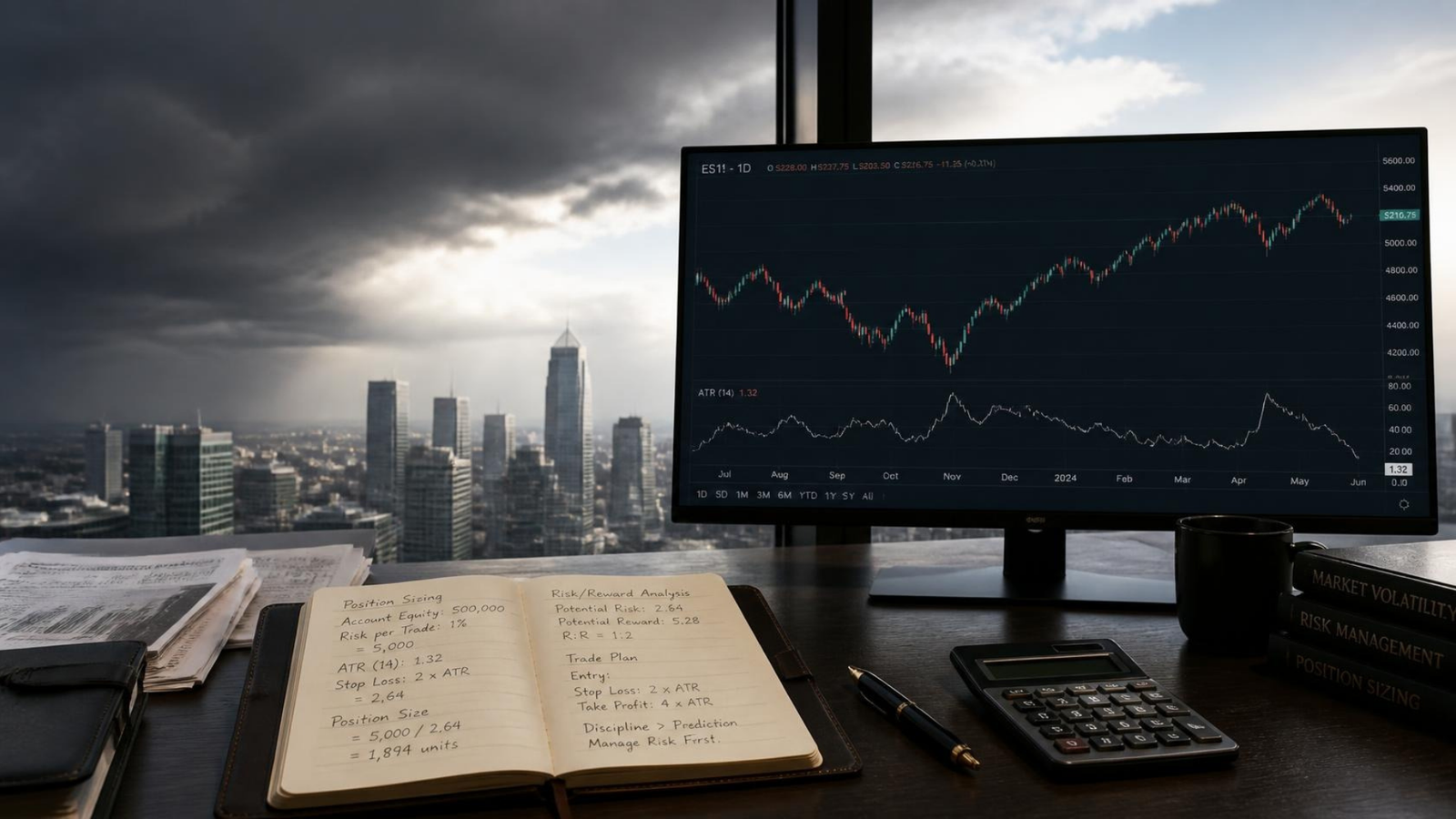
Average True Range (ATR): Why Professional Traders Measure Risk Before They Measure Reward
An editorial reflection on volatility, disciplined risk management, and why surviving the market matters more than predicting it
“Position size should be determined by risk, not confidence.”
— Van K. Tharp
An editorial by Debaditya Chatterjee for INVSTORY.
Financial markets have always rewarded courage.
But they have never rewarded recklessness.
Every trader enters the market with the hope of finding the next profitable opportunity. Charts are studied, indicators are analysed, and economic events are monitored with great attention.
Yet after spending years trading, investing, researching financial markets and educating aspiring market participants, I have observed a simple truth.
Most traders do not fail because they choose the wrong stock.
They fail because they underestimate risk.
The market rarely punishes us for being imperfect.
It punishes us for being unprepared.
Few technical indicators capture that lesson better than the Average True Range, more commonly known as ATR.
Unlike many popular indicators that attempt to identify trends or generate trading signals, ATR asks a far more important question.
How much is this market normally expected to move?
That single question changes the way disciplined traders approach every decision.
An Indicator Born from Market Reality
The Average True Range was developed by J. Welles Wilder Jr. and introduced in his landmark 1978 book, New Concepts in Technical Trading Systems.
Wilder recognised that markets do not move with the same intensity every day.
Some trading sessions are remarkably quiet.
Others experience extraordinary volatility.
Treating both environments in exactly the same way is one of the quickest paths to unnecessary losses.
ATR was created to measure that changing volatility.
It does not predict whether prices will rise or fall.
It measures the magnitude of price movement.
That distinction is both simple and profound.
Professional traders understand that volatility itself carries valuable information.
Knowing how far a market normally moves helps determine whether a stop-loss is realistic, whether a position size is appropriate and whether the potential reward justifies the risk.
Why Volatility Matters More Than Certainty
One lesson becomes increasingly clear with experience.
Markets are uncertain.
Volatility is certain.
Every trading session introduces new information.
Unexpected news, earnings announcements, geopolitical developments and shifts in market sentiment can all influence price behaviour.
No indicator can remove that uncertainty.
ATR does something more practical.
It helps traders adapt to it.
A stop-loss that ignores volatility may be placed too close, causing otherwise promising trades to be exited prematurely.
A position size that ignores volatility may expose far more capital than intended.
ATR encourages traders to respect the market’s natural rhythm rather than impose their own expectations upon it.
That is one of the reasons it continues to remain relevant across equities, commodities, currencies and derivative markets.
The Difference Between Confidence and Risk
One misconception I frequently encounter among newer traders is the belief that confidence should determine position size.
It should not.
Confidence is subjective.
Risk can be measured.
Throughout my own journey as a trader, investor, research analyst and market educator, I have found that experienced professionals often spend far more time calculating downside risk than estimating potential profits.
That approach may appear conservative.
In reality, it is remarkably practical.
A trader who survives periods of uncertainty remains available to participate in future opportunities.
A trader who repeatedly ignores risk eventually loses that privilege.
ATR supports disciplined decision-making because it shifts attention away from prediction and towards preservation of capital.
That mindset often distinguishes professionals from speculators.
ATR Is Not a Trading Signal
Perhaps the greatest misunderstanding surrounding ATR is expecting it to generate buy or sell signals.
That is not its purpose.
ATR does not identify trends.
It does not indicate overbought or oversold conditions.
It does not forecast reversals.
Instead, it provides context.
It answers a question that every market participant should ask before entering a trade.
Is my risk aligned with the market’s current volatility?
That single question can improve stop-loss placement, position sizing and overall risk management far more effectively than searching for perfect entries.
Technical analysis is most valuable when it improves judgement.
ATR embodies that philosophy exceptionally well.
A Lesson Beyond Technical Analysis
The greatest contribution of the Average True Range extends beyond charts and calculations.
It teaches humility.
Markets do not adapt to our expectations.
We must adapt to theirs.
Successful investing and trading have never been about proving ourselves right.
They have always been about managing the consequences of being wrong.
Risk management is not an obstacle to profitability.
It is the foundation upon which long-term profitability is built.
ATR reminds us that preserving capital is not a defensive strategy.
It is a professional one.
From the Editor’s Desk
Over the years, I have realised that markets rarely reward the trader with the strongest opinion.
They reward the trader with the strongest process.
The Average True Range remains one of the most respected indicators not because it predicts tomorrow’s direction.
It does something far more valuable.
It reminds us that every decision should begin with an honest assessment of risk.
The market offers unlimited opportunities.
Our capital does not.
When traders learn to size positions according to volatility instead of emotion, they begin to think less like gamblers and more like professionals.
In the end, successful trading is not defined by how often we are right.
It is defined by how well we manage risk when we are wrong.
That is the enduring lesson behind the Average True Range.
And perhaps, one of the most valuable lessons the market can ever teach.
Editorial written by Debaditya Chatterjee for INVSTORY.