

Diversification: The Mathematics of Protecting Wealth and Managing Uncertainty
MARKET MINDSET
Editorial Journal on Capital Markets, Investment Psychology & Professional Decision-Making
An Editorial by Debaditya Chatterjee
Editor, Market Mindset
Capital Markets Educator | Helping Market Participants Think Like Professionals | Trader & Investor | Market Psychology | Trading Discipline | Capital Markets Research
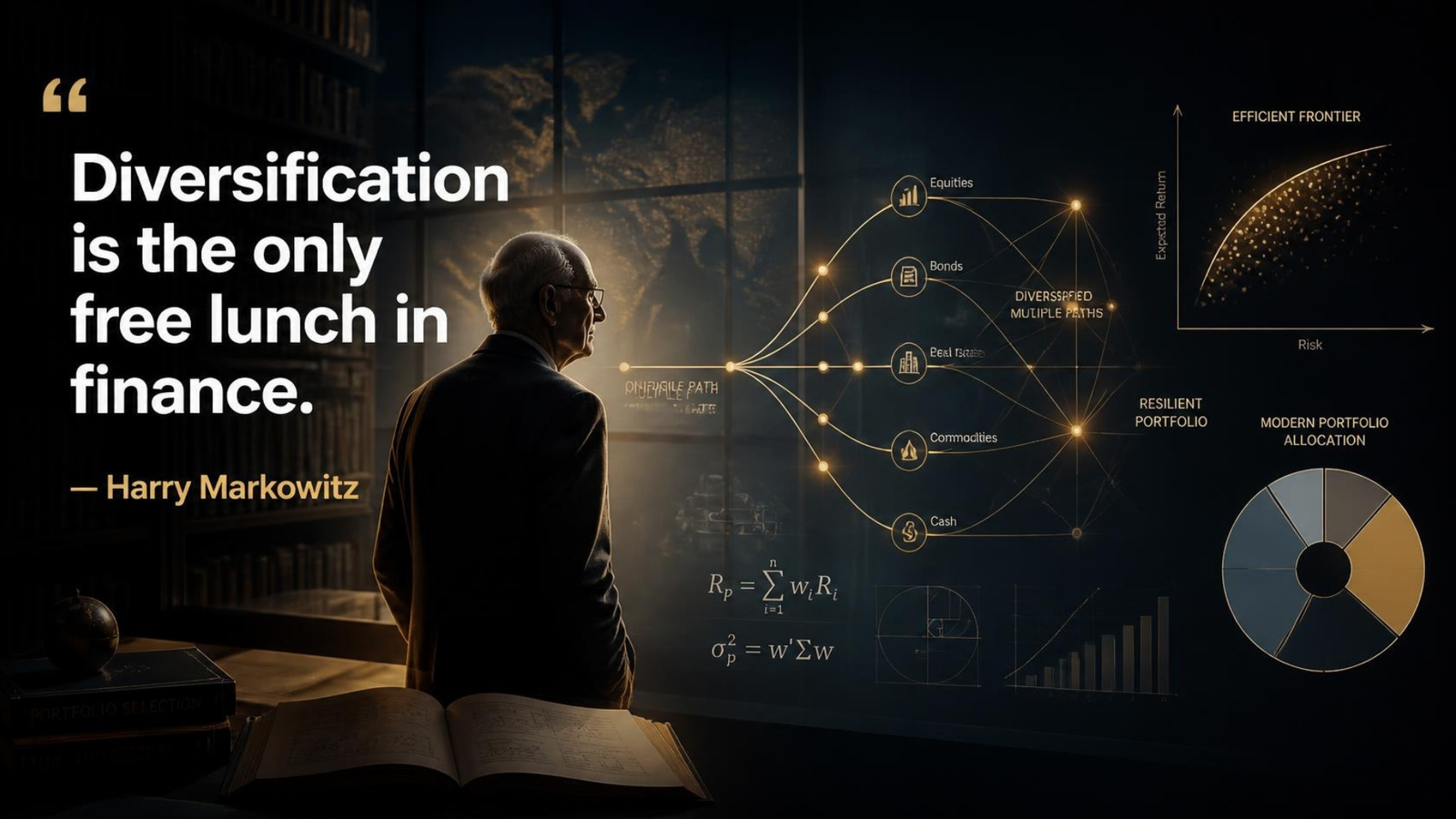
“Diversification is the only free lunch in finance.”
— Harry Markowitz
In financial markets, every investor searches for one thing:
Higher returns with lower risk.
However, achieving both simultaneously has always been one of the greatest challenges in investing.
Harry Markowitz, the Nobel Prize-winning economist and pioneer of Modern Portfolio Theory, introduced a powerful idea that changed the way investors think about risk.
The answer was not simply finding the best investment.
It was understanding how different investments behave together.
That principle became the foundation of diversification.
Diversification Is Not About Owning Everything
One of the biggest misconceptions about diversification is that it simply means buying a large number of stocks.
It does not.
Owning fifty companies from the same sector is not true diversification.
Owning multiple assets that respond differently to economic conditions is closer to the original idea.
The objective is not to eliminate risk completely.
That is impossible.
The objective is to reduce unnecessary risk while preserving opportunities for growth.
A professional investor does not ask:
“How many investments do I own?”
The better question is:
“How differently do my investments behave when conditions change?”
The Mathematics Behind Diversification
Markowitz’s contribution was based on a simple but powerful insight:
The risk of a portfolio depends not only on the individual risk of each asset but also on how those assets move in relation to each other.
Two highly volatile investments may create a more stable portfolio if their movements are not perfectly correlated.
This concept of correlation is at the heart of portfolio construction.
When one investment faces pressure, another may provide balance.
The result is not guaranteed protection.
It is improved risk management.
This is why professional investors focus not only on returns but also on the quality of those returns.
Why Professional Investors Think Differently About Risk
Many new investors measure success only through returns.
Professional investors measure success through risk-adjusted returns.
A portfolio generating strong returns with uncontrolled risk may not be sustainable.
Markets move through different cycles.
Economic expansions.
Interest rate changes.
Sector rotations.
Unexpected events.
A concentrated portfolio may perform exceptionally during favourable conditions but suffer significantly when circumstances change.
Diversification creates resilience.
It gives investors the ability to survive uncertainty and remain invested through different market environments.
The Psychology Behind Diversification
The greatest benefit of diversification is not only mathematical.
It is psychological.
Concentration increases emotional pressure.
When an investor’s entire wealth depends on a few positions, every price movement feels personal.
Fear increases.
Decision-making becomes reactive.
Diversification reduces emotional intensity by preventing a single investment from dominating the entire outcome.
This allows investors to think more objectively.
The ability to stay disciplined during difficult market conditions is often more valuable than achieving exceptional returns during favourable periods.
The Difference Between Concentration and Recklessness
Successful investors understand that concentration and diversification are not opposites.
Many legendary investors have achieved extraordinary results through focused investments.
However, concentration requires deep knowledge, extensive research and the ability to accept significant volatility.
For most market participants, excessive concentration is often not a sign of confidence.
It is a hidden form of risk.
Professional investing requires understanding the difference between taking calculated risk and unknowingly exposing capital to unnecessary uncertainty.
Diversification in Modern Markets
Today’s investors have access to thousands of stocks, mutual funds, exchange-traded funds and alternative assets.
Yet the fundamental principle remains unchanged.
More choices do not automatically create better portfolios.
Better understanding does.
A thoughtfully constructed portfolio considers:
Asset allocation.
Sector exposure.
Risk tolerance.
Investment horizon.
Correlation between holdings.
Market conditions.
Diversification is not a mechanical process.
It is a decision-making framework.
The Professional Perspective
Markets will always contain uncertainty.
No investor can predict every economic event, market cycle or company outcome.
Diversification acknowledges this reality.
It accepts that uncertainty exists and builds a structure capable of handling it.
The objective is not to avoid every loss.
The objective is to ensure that one mistake does not permanently damage long-term wealth creation.
That is the true power of diversification.
From the Editor’s Desk
Over the years, one lesson has become increasingly clear:
Successful investing is not only about identifying opportunities.
It is about managing uncertainty.
The best investors understand that even excellent ideas can face unexpected challenges.
Companies change.
Industries evolve.
Markets surprise.
Diversification is not a guarantee of profits.
It is a framework for survival.
And in investing, survival is the foundation of long-term success.
Harry Markowitz’s timeless principle continues to remind investors of a fundamental truth:
The goal is not to predict every outcome.
The goal is to build a portfolio strong enough to withstand uncertainty while participating in opportunity.
That is why diversification remains one of the most powerful concepts in modern investing.
About the Editor
Debaditya Chatterjee is the Editor of Market Mindset, an editorial publication focused on capital markets, investment psychology and professional decision-making.
As a Capital Markets Educator, Trader & Investor, he writes about behavioural finance, portfolio management, technical analysis, risk management and evidence-based investing, helping market participants develop professional thinking and disciplined decision-making frameworks.
Editorial Disclaimer
This editorial is published solely for educational and informational purposes. The views expressed are intended to encourage informed discussion on investing, portfolio management, risk management and financial markets.
Nothing contained in this publication should be interpreted as investment advice, research recommendations or an offer to buy or sell any financial instrument. Readers should conduct their own independent research and consult qualified financial professionals before making investment decisions.