

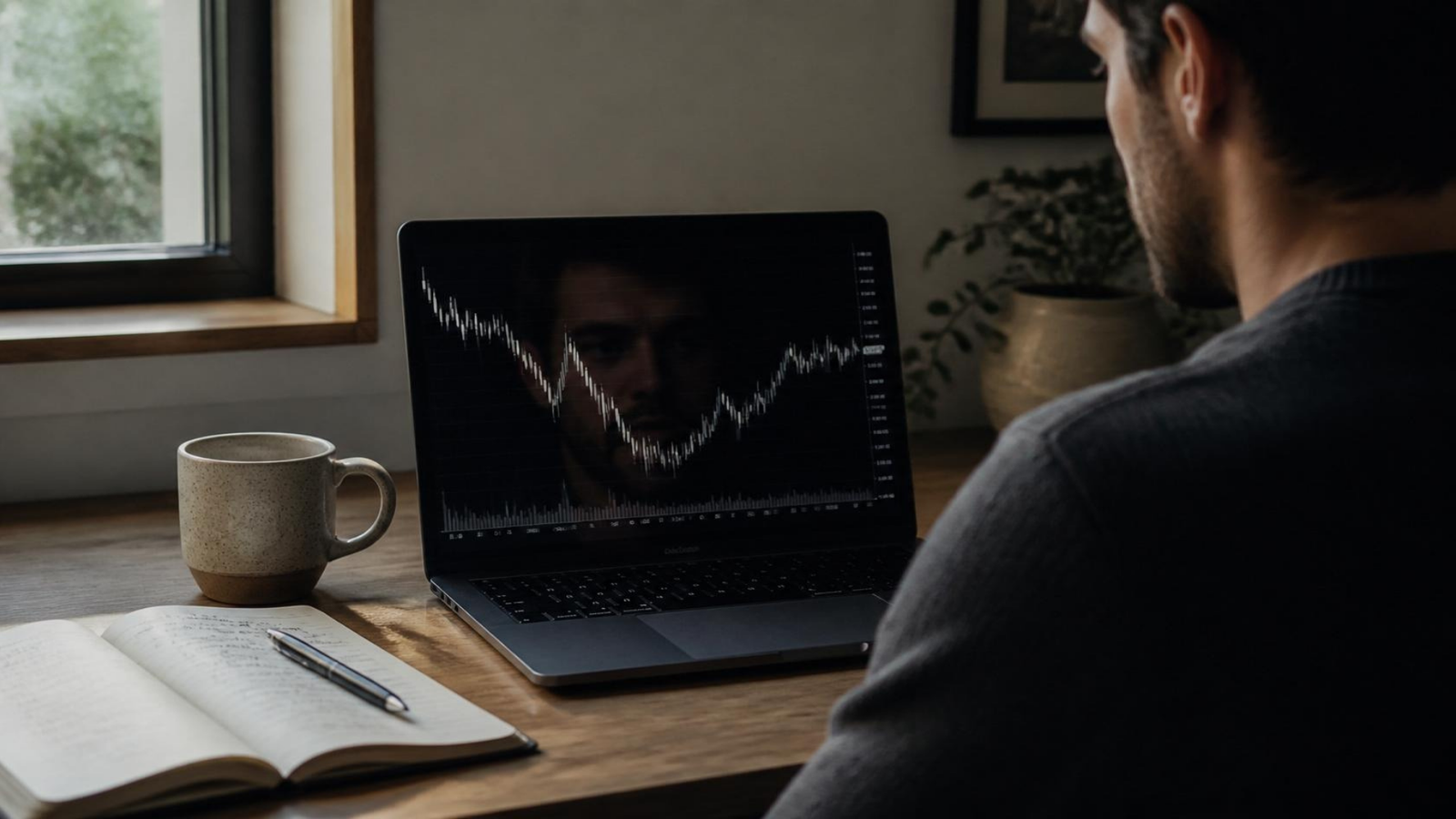
Trading Psychology: Why Your Trading Mirrors Your Life
A reflection on trader mindset, emotional discipline, behavioural finance, and decision-making inspired by Brett Steenbarger
“Your trading psychology mirrors your life psychology.”
— Brett Steenbarger
An editorial by Debaditya Chatterjee for INVSTORY.
The Most Important Market You Will Ever Study Is Yourself.
Every day, millions of participants enter the financial markets believing that success depends on finding a better trading strategy, a more accurate technical indicator, or a superior market forecast.
Many spend years searching for the perfect setup.
Few spend enough time understanding the person executing that setup.
That distinction separates information from transformation.
Among the most respected voices in modern trading psychology is Brett Steenbarger—a trading psychologist, author, and performance coach whose work has influenced professional traders, hedge funds, and investment firms across the world. Rather than searching for shortcuts to market success, Steenbarger has consistently advocated self-awareness, emotional discipline, deliberate practice, and continuous improvement as the foundations of long-term trading performance.
His philosophy is captured in one powerful sentence:
“Your trading psychology mirrors your life psychology.”
It is not merely a statement about trading.
It is a statement about human behaviour.
Every Trading Decision Begins Before the Market Opens.
Long before a trader analyses a candlestick chart or studies price action, habits are already influencing decisions.
Patience.
Discipline.
Preparation.
Impulsiveness.
Fear.
Confidence.
These qualities are rarely created by the market.
The market simply reveals them under pressure.
This is why experienced professionals often say that the financial markets act like a mirror rather than a classroom.
They expose strengths that we rarely notice during ordinary circumstances.
They also expose weaknesses we often prefer to ignore.
The trading screen therefore becomes far more than a place where prices move.
It becomes an environment where character is continuously tested.
Trading Psychology Is the Foundation of Consistent Trading.
Most traders believe better results come from discovering better strategies.
Professional traders understand that even the best trading strategy can fail when execution lacks discipline.
Two market participants may study the same technical analysis.
They may recognise the same chart pattern.
They may identify the same risk-reward opportunity.
Yet one follows the trading plan with consistency.
The other exits early because of fear, increases position size because of greed, or ignores risk management because of overconfidence.
The difference rarely lies in the chart.
It almost always lies in behaviour.
That is why trading psychology remains one of the most valuable yet underestimated skills in successful trading.
Behavioural Finance Begins Where Emotions Meet Decisions.
Behavioural finance teaches us that investors and traders are not perfectly rational.
Human beings carry cognitive biases into every important financial decision.
Loss aversion.
Confirmation bias.
Overconfidence.
Recency bias.
Fear of missing out.
These behavioural tendencies influence both investing and trading.
Recognising them does not eliminate them.
It allows us to manage them.
Self-awareness therefore becomes one of the most valuable forms of risk management available to any trader or investor.
The Best Trading Journal Records More Than Trades.
Many traders maintain detailed records of entries, exits, profit, and loss.
Far fewer record what they were thinking before making those decisions.
A complete trading journal should answer questions such as:
Why did this trade feel attractive?
What emotion influenced my execution?
Did I follow my trading plan?
What can I improve next time?
Markets provide feedback every trading day.
The trading journal transforms that feedback into continuous improvement.
Without reflection, experience becomes repetition.
With reflection, experience becomes learning.
Success in Financial Markets Begins Away from the Charts.
The habits that improve trading often improve everyday life as well.
Preparation creates confidence.
Discipline creates consistency.
Patience improves decision-making.
Humility encourages learning.
The opposite is equally true.
Impulsive behaviour outside the market often becomes impulsive trading inside the market.
The trader cannot permanently separate personal habits from professional decisions.
That is precisely why Brett Steenbarger’s insight remains timeless.
Trading psychology mirrors life psychology because both emerge from the same individual making decisions under uncertainty.
The Greatest Competitive Advantage Is Self-Awareness.
Modern financial markets provide extraordinary technology.
Real-time data.
Artificial intelligence.
Sophisticated charting platforms.
Advanced market analysis.
Yet none of these tools can replace disciplined thinking.
The strongest competitive advantage is still the ability to recognise our own emotional patterns before they influence financial decisions.
Charts reveal market behaviour.
Experience reveals personal behaviour.
The combination of both creates mature decision-making.
A Final Reflection.
Brett Steenbarger’s contribution extends far beyond trading psychology.
He reminds us that successful trading is ultimately a process of personal development.
Markets do not simply measure analytical ability.
They measure patience.
Discipline.
Humility.
Consistency.
Emotional resilience.
Every trading decision reflects the person making it.
Improve the individual, and decision-making begins to improve naturally.
Because the greatest transformation in financial markets rarely begins with a new indicator.
It begins with a better version of the trader looking at the screen.
Continue the Conversation
At INVSTORY, we believe exceptional investing and trading begin with continuous learning, disciplined thinking, and evidence-based decision-making. Through trading psychology, behavioural finance, technical analysis, risk management, and investor education, we aim to help traders and investors build sustainable frameworks for long-term success in the financial markets.
© 2026 INVSTORY. An editorial by Debaditya Chatterjee.